"No" in love - Turning Parental Walls into Boundaries
Blog post description.
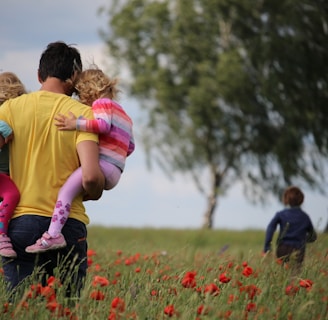
What a child feels when they hit a barrier
A barrier isn’t just a “no.”
A barrier is:
– “You overwhelm me.”
– “I can’t handle you.”
– “My love is unavailable.”
– “Your being is too much.”
Even if we don’t say the words,
the child feels the message.
Their small nervous system reorganizes itself:
How do I stay loved?
How do I make myself safer?
How do I avoid losing connection?
This is how adaptations are born.
What a boundary feels like instead
A boundary is different in the body.
It says:
“I love you.
And this behaviour stops here.
But the connection — this —
is safe.”
A boundary protects the relationship.
A barrier threatens it.
Boundaries regulate a child.
Barriers dysregulate them.
Boundaries teach safety.
Barriers teach self-sacrifice.
Why boundaries feel so uncomfortable for us
Because our inner child still remembers the wall.
Saying “no” brings up the old wound:
the fear of losing love,
the fear of being too much,
the fear of being wrong,
the fear of repeating what was done to us.
And that fear activates our system,
which makes us more likely
to respond with…
another wall.
So it’s not just our child hitting the wall.
We are hitting our own wall at the same time.
Softening our walls is the key
A boundary cannot exist
until the parent’s barrier softens.
We need to feel the part of us that never had boundaries —
the little one inside who only knew:
anger
withdrawal
disapproval
silence
coldness
punishment
When we hold that part with love,
something softens.
And from that softness,
a boundary emerges naturally.
Not from a technique.
Not from a script.
Not from forcing the voice to sound calm.
But from our nervous system opening
to connection and firmness at the same time.
This is the shift:
The child stops adapting…
because the parent stops collapsing.**
This is how we raise children who feel safe even in conflict.
Children who can hear “no” without losing themselves.
Children who remain connected to their authenticity.
Children who don’t have to trade truth for attachment.
This is the revolution.
It begins with us.
With our bodies.
With our breath.
With softening the walls we inherited.
🎧 Listen to the full episode:
“No" in Love...
We Were Raised With Walls: How Softening Our Past Teaches Our Children True Boundaries
There is a sentence that changed my entire understanding of parenting:
“A boundary says no to the behaviour.
A barrier says no to the child.”
And most of us, if we’re honest,
were raised with barriers, not boundaries.
We grew up with walls.
Walls of anger.
Walls of shutdown.
Walls of “go to your room.”
Walls of silence.
Walls of punishment.
Walls of feeling like love disappeared when we got something wrong.
So of course we feel confused now.
Of course we collapse.
Of course we get activated.
Of course holding limits feels uncomfortable.
We are trying to offer our children something
we never experienced.
R•WISE (Relational Women’s Integration & Somatic Embodiment) - A Midwifery approach to Inner Change
Attune your body and soul to harmony.
© 2025. All rights reserved.
Christchurch - New Zealand.